Automating SME work and infrastructure with ADKPart 5 of 11
A Better Morning for Infrastructure Teams: Organizing Monitoring and Daily Checks with ADK
Design ADK-assisted morning checks for a small business: define order-service SLIs, limit data access, prioritize alerts, and verify reports with a practical worksheet.

In this article
What you will learn
Connect morning checks to order and warehouse decisions.
Separate validated numbers from AI hypotheses in reports.
Record priority, ownership, deadlines, and receipt.
Part 5 of the series | Build business automation around the morning check. Technical information verified as of October 14, 2026.
Open the monitoring dashboard first thing in the morning. Check last night's backup. Search the logs when a customer mentions that the service is slow. Look at the cloud spending forecast and recall yesterday's changes. At a small or medium-sized business, the person responsible for infrastructure often does all of this while also configuring devices and answering internal questions. Working through the screens can take much of the morning.
This work combines decisions that require someone to take responsibility with the repeated task of collecting information from the same places. Organizing the latter gives the person more room to investigate what needs attention. Google's Agent Development Kit, ADK, is one possible foundation for connecting that collection work to a useful explanation.
This article proposes a single morning report that makes the evidence and the responsible person visible. We use a fictional equipment and parts distributor, Company A, which operates an order service, to consider what to measure, what AI should read, and who should receive an issue. The company, figures, and procedures are hypothetical design examples. They do not describe a customer deployment or results already achieved.
1. What We Can Learn from Google SRE's Use of AI
In May 2026, Google identified ADK as a development platform for its SRE AI program and described agent support for playbooks, incident investigation, and communication. It did not establish the framework used by every component or isolate ADK's contribution to results. Google's announcement
The useful idea is to make operational information usable for the person responsible. A smaller company does not need to reproduce Google's organizational scale or operating model. It can start by defining the daily checks and the escalation contact for one internal service.
A reported operational deployment, an official implementation sample, and a proposed design for your company have different kinds of evidence behind them. Running ADK code successfully still leaves the question of whether it can safely support the actual order service. The design in this article is a proposal for SMEs inspired by the reported use case.
2. Define the Decisions You Need to Make Each Morning
In our scenario, Company A has 35 employees. Business customers enter orders through a portal, and the data is transferred to the warehouse. One person covers both internal IT and infrastructure. The sales manager makes decisions about the order business, while an external maintenance provider investigates application issues. Orders continue on the days when the internal person is away.
We narrow the company's morning decisions to three questions:
- Can customers have their orders accepted?
- Are accepted orders reaching the warehouse by the required time?
- Are there risks or unfinished tasks that someone must address today?
A list of CPU and memory readings cannot answer those questions on its own. Successful order acceptance, transfer delays, and checks of recovery procedures need to be linked to their business meaning. Defining the purpose first also reduces the data the AI needs to read.
For backups, for example, collect more than the last job's success status. Include the data covered, the point in time through which it was saved, and the date of the last restoration test. Those details let the responsible person judge the situation. If no restoration test has been performed, record that as unverified. A more detailed report does not mean that the underlying check has been carried out.
3. Adapt SRE Ideas to a Small Team's Checks
SRE uses the term toil for operational work that is manual, repetitive, lacks enduring value, and grows with the service. Daily work can include both analysis that leads to improvement and the repeated transcription of the same information. Google SRE: Eliminating Toil
Our fictional company reviews the previous week and records what was checked in the same sequence every day, what was delayed by searching for information, and what required human judgment. It then organizes the starting points for its checks.
Area: Order acceptance
Question to answer: Does the customer's order reach acceptance?
Evidence: Requests at the service entry point, acceptance results, receipt IDs
Area: Warehouse transfer
Question to answer: Are unprocessed orders accumulating?
Evidence: Transfer ledger, processing timestamps, failure categories
Area: Backups
Question to answer: Are coverage and restoration checks documented?
Evidence: Job results, saved-through timestamps, restoration test records
Area: Certificates and other expirations
Question to answer: Is there an owner and a renewal plan?
Evidence: Expiration register, renewal schedule, assigned person
Area: Capacity and spending
Question to answer: Can increases be explained?
Evidence: Usage trends, spending forecasts, change history
Selecting only data that is easy for AI to interpret can omit necessary checks. Start with what the company's ordering, shipping, and cutoff times require, then decide how to obtain it. Records such as restoration tests can remain human-entered while the first version is built.
4. Define One SLI That Measures the Customer's Experience
SRE monitoring describes four basic signals: latency, traffic, errors, and saturation. Google SRE: Monitoring Distributed Systems
Here we translate them into a proposed measurement for order processing. An SLI measures a service's condition; an SLO is the level you aim to achieve for that indicator. Writing down the measurement before asking AI whether the service is healthy makes the judgment more consistent from day to day.
Counting Successful Acceptance
In this example, the denominator is the set of requests that meet the company's input and authentication requirements and reach the order service's entry point. A request counts as successful when a receipt ID is issued and the request is recorded in the acceptance ledger. Internal errors and response timeouts count as failures. Define how the same request ID is recognized so that resubmissions are not counted as new orders.
If illustrative data contains 200 eligible requests and 198 successful acceptances, the success rate is 99%. However, this indicator alone cannot reveal customers whose requests never reached the entry point because they could not place an order. Use separate observations, such as periodic tests from the interface through acceptance and customer inquiry counts. These numbers are a fictional calculation, not a recommended SLO or a measured result.
Fix the Time Window and the Meaning of Latency
For acceptance latency, measure from the time a request enters the service until the receipt ID is returned. Separate the durations of successful and failed requests, and state the aggregation window. Avoid directly comparing low overnight traffic with the morning order rush.
For warehouse transfers, examine the acceptance time of the oldest unprocessed order as well as the last successful transfer. This distinguishes a quiet period with no orders from a transfer process that has stopped progressing despite incoming orders. Sales and maintenance representatives should decide the SLO values in light of shipping impact and cost.
5. Give the ADK Workflow Five Responsibilities
ADK 2.0 graph workflows connect AI steps and ordinary functions through explicit sequences and branches. The documentation lists support for Python, TypeScript, and Go, with some third-party integration combinations remaining incompatible. ADK: Graph workflows
For the morning check, propose the following flow:
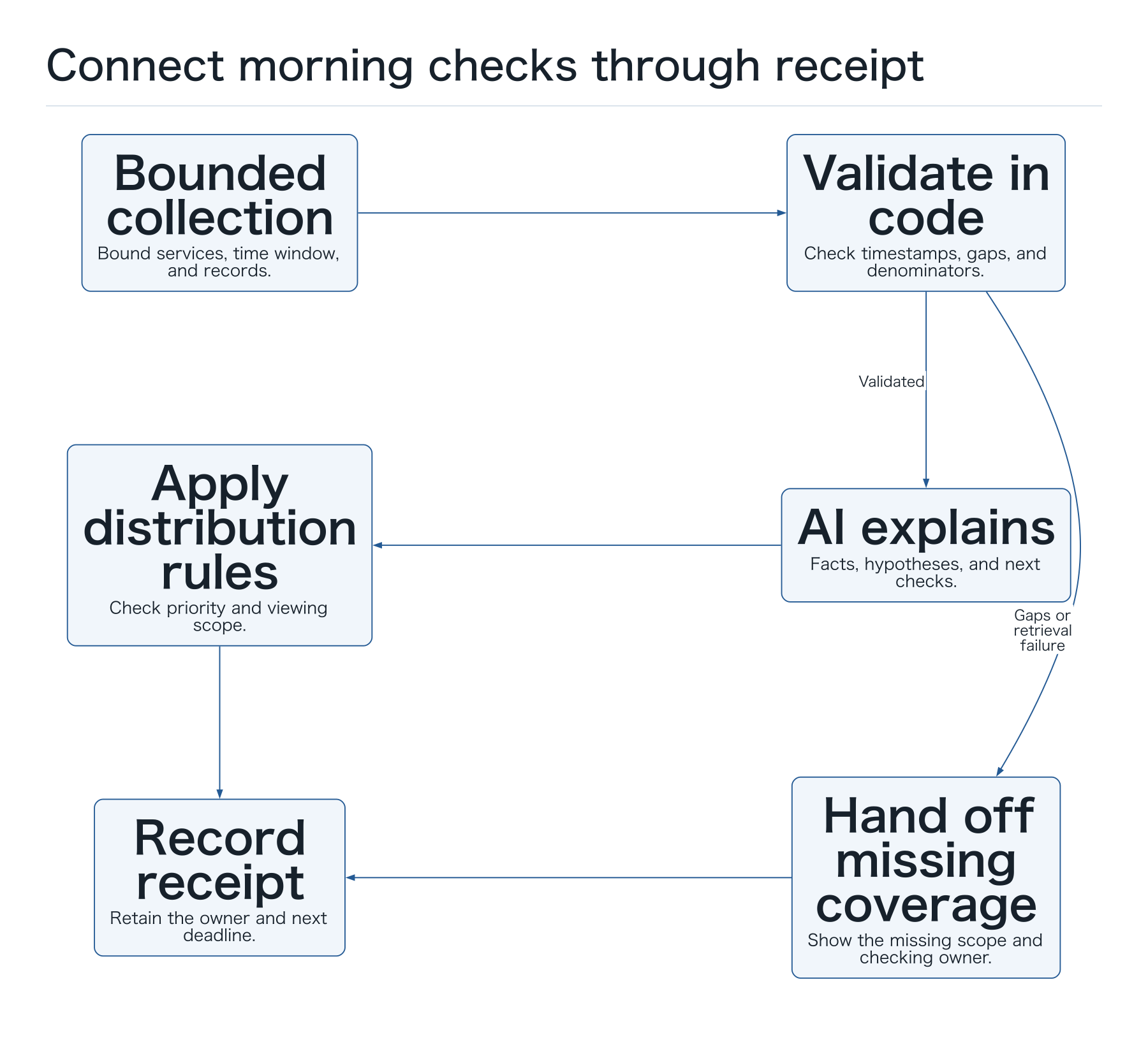
- Collect. Retrieve metrics, job results, and change history for authorized services within a defined time window.
- Validate in code. Check timestamps, targets, missing data, and aggregation denominators, then calculate the defined SLI.
- Explain with AI. Organize changes from the previous day, possible business implications, and additional checks, attaching evidence.
- Apply distribution rules. Determine priority and ownership through rules, and check who is allowed to view the report.
- Record the handoff. Save the report time, references, reviewer, and next deadline in a register.
Independent reads, such as log and capacity queries, can be designed to run concurrently. Aggregation and reporting follow the necessary sequence once the data is available. If a log query fails, the AI must identify the missing coverage rather than invent replacement figures.
Fixing the flow in code still leaves the AI's explanation to be evaluated separately. Even if its prose says that everything is fine, missing data in the validation result should cause the report to be handed to someone for review.
 Open full-size diagram
6. Limit the Scope Even When You Start with Reads
Monitoring data can contain customer identifiers, order details, internal architecture, and strings related to credentials. Removing write permissions does not make every use safe. Design the scope so that unnecessary information is not read.
Company A's checking tools accept service IDs, permitted time ranges, and row limits. This follows least privilege: permit only the targets and actions needed. A user cannot freely specify a customer ID to retrieve another company's logs. Where data is separated by business customer, the retrieval code checks the relationship between the authenticated user and the target customer.
The data passed to AI is restricted to fields needed for the investigation, with unnecessary personal information and credentials removed from the display dataset. People who need detailed logs receive a link to the original behind existing authentication. The information available to sales staff and to the maintenance provider is also separated.
Text in a log that says something like “ignore previous instructions” remains observed data. It receives no authority to change access targets or report recipients. From the prototype stage, tools should check permissions, removal of confidential fields, and permitted reference destinations.
7. Make Facts, Hypotheses, and Next Checks Easy to Read
A summary of a long log can still be difficult to use. Give the morning report a structure that lets its reader decide what to do next:
Observed fact: Order acceptance errors increased during the specified window. State the retrieval scope and aggregation time.
AI hypothesis: A recent change may be related. Similar timing alone does not establish a cause.
Unverified: The customer's path from the interface through acceptance, and the external integration's responses.
Next check: The infrastructure owner checks the entry path and asks the maintenance provider to review the change diff.
Owner and deadline: Name the investigation owner, business communication owner, and next update time.
A comparison such as “slower than yesterday” should include the window, request count, and latency aggregation method. If only part of the logs was read, the display must not imply that all records were reviewed. Wording should also distinguish evidence of a service-wide issue from problems found in particular requests.
At the end of the report, record the generation time, latest timestamp of the referenced data, target service, and checking-rule version. A later reader can then tell which state the report described. Preserve the earlier report and the human review result even when the AI generates an update.
8. Define Priority and Handoff Contacts Before Sending Alerts
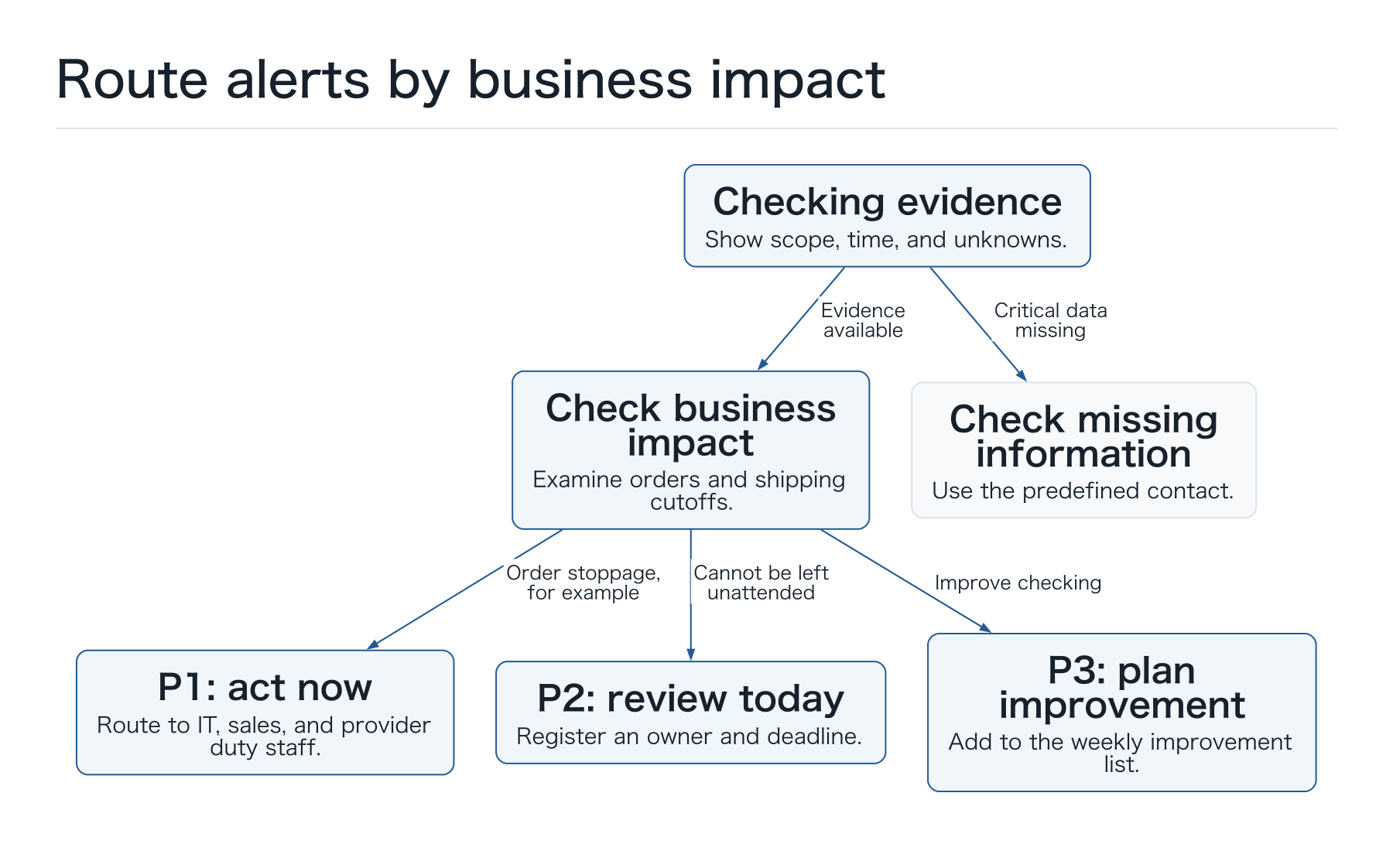
When the same warnings appear every morning, people can begin to postpone reading them. Our fictional company links priority to business impact and review deadlines. The following is an example classification to agree internally:
- P1: Act now. Order acceptance is stopped with confirmed customer impact, or a confirmed backlog threatens the shipping cutoff. Contact the infrastructure owner and sales manager, and hand the issue to the maintenance provider's duty contact.
- P2: Review today. Capacity growth or a failed job is not immediately stopping order acceptance but cannot be left unattended. Register an owner and a review deadline.
- P3: Plan an improvement. Duplicate checks and procedure updates go on the weekly improvement list.
If information for a critical service cannot be retrieved, do not treat it as healthy. Send a review request to the predefined contact. Conversely, multiple alerts associated with the same possible cause can be linked to one investigation. Record the reason for grouping them so that independent incidents are not incorrectly merged.
Every notification needs an owner and a next update time. A generated report does not complete a handoff until receipt by the responsible person has been confirmed. Agree on a substitute for absences or unreachable contacts outside the checking system as well.
 Open full-size diagram
9. Use a Small Evaluation Set to Check Misses and Excess Alerts
For early evaluation, anonymize past records as needed and have the responsible person label the expected judgment and its reasoning. Include normal days, delayed transfers, incomplete log retrieval, and incidents that subsided without intervention. A dataset with only similar outcomes will not test the boundaries.
For example, review these questions:
- Are the referenced time and target service correct?
- Are values and denominators preserved when written into the report?
- Does missing data avoid being reported as healthy?
- Does a hypothesis remain a hypothesis rather than become a confirmed cause?
- Is unauthorized customer information kept out of retrieval and display?
- Do the owner and review deadline follow the company's operating rules?
Measure more than report generation time. Record the time people spend rechecking originals, corrections, missed issues, and unnecessary alerts. If a quickly generated AI report increases the human checking burden, it is moving away from the purpose of adoption.
During the first period, run the report alongside the existing checks and compare the differences. Do not immediately claim savings by comparing days with different business activity or traffic. Use consistently defined checks to compare human handling time and quality before and after adoption.
10. Prepare Operating Costs and Stop Conditions
Include log retrieval, storage, cloud execution, human review, and maintenance, as well as the cost of generating a report. A design that keeps reading logs without defining periods and row counts makes time and cost difficult to estimate.
As an initial design for Company A, put limits on the period and records read, processing time, and model calls per check. When a limit is reached, report the facts obtained and the missing scope, then hand the case to someone. Restrict retries to predefined conditions such as temporary retrieval errors, with bounded attempts and waiting periods.
Manage each daily report under a unique key made from its target date and service. Check generation, distribution, and receipt states so that two starts of the same check do not produce duplicate notifications. If the delivery response disappears, verify whether the report arrived before deciding to resend it. Even a workflow centered on reads has side effects in notifications and register entries.
Keep the existing monitoring alerts and human check procedure available if the AI component stops. Map operational dependencies so that a reporting failure does not stop the order service or remove monitoring coverage.
11. A Daily Check Design Worksheet
Complete the following with the infrastructure owner and sales manager. Treat blanks as unresolved questions to settle before the prototype; do not ask AI to guess them.
- Business task: Which user must be able to complete what?
- Scope: Services, customers, time windows, and record limits.
- SLI: How to count the numerator, denominator, success, failure, duplicates, and missing data.
- Target and deadline: The level to aim for and the review deadline.
- Evidence: Sources and timestamps for metrics, ledgers, job records, and change history.
- AI responsibility: Comparisons, explanations, unverified items, and possible additional investigations.
- Code responsibility: Aggregation, access checks, notification conditions, and state management.
- Human responsibility: Review, business impact decisions, and work approval.
- Handoff: Primary owner, substitute, receipt confirmation, and next update time.
- Stop and resume: Conditions for stopping automated reports and who can resume them.
- Evaluation: Missed issues, excess alerts, correction time, and cost per completed check.
Once completed, review the worksheet as if the usual person were away that morning. Can the reader understand the order service's state, notice what remains unverified, and find the contact? This exercise prepares for AI adoption while also improving checks that depend on one person's knowledge.
12. A Proposed First Four Weeks
In week one, agree on checks and decision definitions. Focus on one task, such as order acceptance, and document the existing monitoring, ledgers, and human procedure. Decide how to obtain missing observations rather than fill the gap with AI prose.
In week two, build reports with a restricted dataset. Use test data to verify numbers, references, and missing-data labels. Confirm that the permitted scope remains intact when inputs contain requests for unauthorized access or instructions embedded in external data.
In week three, run alongside the existing checks. Record human review time and unnecessary alerts as well as report accuracy. Limit recipients to the relevant people and refine priority classification.
In week four, choose the scope to continue. Move consistently verified checks into daily use and keep human review for areas lacking evidence. This four-week sequence is a suggested approach, not a promised deployment duration or outcome.
Once the morning report is useful, organize investigation and handoffs during an incident. Part 6 uses the same order service to explore an SRE design that separates AI hypotheses, human approval, and recovery execution.
To review your company's checks, share the target service, current procedure, and difficult handoffs with KONDAX. Those details provide a starting point for considering what to measure and which tasks might suit automation.
Three checks before practice
- Are order-success denominators and missing-data rules consistent?
- Do hypotheses remain distinct from confirmed causes?
- Are receipt and the next update clear when the primary owner is absent?