Automating SME work and infrastructure with ADKPart 8 of 11
From a Small Trial to Daily Use: A 90-Day ADK Adoption and Evaluation Plan
Plan a 90-day ADK trial for one business task, with baselines, shadow runs, deferral and completion checks, regression evaluation, costs, ownership, and stop criteria.

In this article
What you will learn
Trial one task in stages and decide whether to continue.
Evaluate tools, outputs, business completion, and operations separately.
Include deferrals and human burden in advancement decisions.
Part 8 of the series | Verify quality, costs, and ownership around one business task. Technical information verified as of October 14, 2026.
Quotation drafts appear. Invoice differences are listed. Morning checks can be summarized. Once a prototype does these things, it is tempting to add more tasks. Daily work, however, includes incomplete inquiries, absent approvers, and unavailable external services. A continuation decision needs a plan for how people will keep the work moving under those conditions.
This final article proposes a 90-day plan to trial one task, evaluate it, and decide its continuing scope. It is a suggested adoption plan for readers, separate from the roughly two-month publication schedule for this eight-part series. It does not promise company-wide automation or results within 90 days.
We continue with Company A, the fictional equipment and parts distributor with 35 employees. The first task is to organize sales inquiries and hand a reviewable quotation draft to the responsible person. The company, volumes, times, and decision conditions are hypothetical. The designs for accounting, knowledge, monitoring, incidents, and costs covered earlier support this task where relevant.
1. Separate a Monitoring Integration from Your Business Results
Google and Datadog's joint article describes automatic instrumentation for ADK, covering tool traces, tokens, latency, errors, and quality evaluation. This is an available integration, not evidence of time savings achieved by a particular SME. Google and Datadog's joint article
Measurement provides a starting point for investigating what happened during execution. Your goal, however, is to hand over a draft with the required conditions, rather than merely consume tokens or call a tool. Connect execution history with business completion records when evaluating outcomes.
Running an official implementation sample, processing a test case, and having real users rely on it daily are also different stages. Use reported integrations and company announcements as context, then verify your own target task rather than relabeling those reports as your results.
2. State the Question You Want to Answer after 90 Days
Company A's question is: can we hand complete, reviewable quotation drafts to the responsible person during busy periods while reducing missed checks and rework? AI usage itself is not a completion criterion. Specify who receives what so that the work can move forward.
Limit scope to drafts based on registered customers and approved product information. Return exceptional contract terms, unregistered products, and unconfirmed delivery dates to a person. During the first 90 days, evaluate through the point where the reviewer checks the conditions and receives the draft. Separate this from order or revenue growth.
The handoff table lists the inquiry sender, inputs, steps, draft and unverified items, and receiving person. When more information is required, state what goes back to whom. If approval, sending, or registration are added later, update completion criteria for each.
The 90-day decision: Continue, revise and retry, or return to the previous process. Review quality, human burden, costs, and responsibility in the same document.
3. Use the First 30 Days to Establish a Baseline and Owners
The first period measures current work and verifies usable data. Record human handling time from receiving an inquiry through asking for missing information, checking products and conditions, and drafting. Record approval waits and customer-response waits separately as elapsed time.
Collect returned work, missing-information cases, similar products, and external-service failures as well as representative normal cases. When using real data, handle necessary fields within its purpose and access scope. Keep unnecessary information out of evaluation datasets.
A One-Row Template for the Baseline
Record intake date, case type, whether required information was present, handling start and end, follow-up question counts, waiting time, returned work, and completion state. Separate time spent on other work between start and end from human handling time. If you cannot measure individual seconds accurately, agree on consistent units and a method internally and display the measurement's precision.
Use the same template after adoption. Do not directly compare an average after difficult cases were excluded with an earlier average covering all cases; attach scope conditions. Record changes outside AI too, such as a different sales representative, a busy period, or cleaned-up product data. A difference in results should not automatically be attributed entirely to ADK.
Assign responsibility for business rules, implementation and operation, draft review, exception handling, and stopping the system. Keep separate role fields even when one person combines them. Confirm substitute contacts, procedures for returning to manual work, and the maintenance provider's coverage.
At day 30, check whether eligible scope, baseline measures, exception destinations, evaluation cases, and retrieval permissions are defined. Do not fill unresolved permissions or completion criteria with model guesses to meet the date. Narrow scope or remain at this stage if these items are not ready.
4. Move from Shadow Runs to Limited Draft Presentation in Days 31–60
Begin with a shadow run: continue the existing work while comparing AI results in the background. Do not send to customers or make definitive ledger updates. Let the reviewer inspect what was extracted, which sources were used, and where the system deferred a decision for the same input.
The purpose is not to select only cases that AI handles well. Test whether normal work, missing information, exceptions, incorrect inputs, and insufficient permissions follow the expected branches. Keep labeled evaluation cases with human-approved outcomes and evidence separate from cases used for development tuning.
Present drafts to reviewers for the scope that becomes stable. Show references, calculation results, unverified conditions, and suggested follow-up questions. Record human corrections and distinguish normal review time from time spent correcting exceptions.
For an illustrative inquiry such as “20 of the same part as last month, by next week,” first check whether access to purchase history is permitted. Even when one product is identified, check current price, quantity, and delivery conditions individually. If identification remains uncertain, return candidates and questions. In this shadow run, compare the same input with ordinary human handling and record differences in extraction, reconciliation, and deferral.
Give the draft recipient a way to record decisions such as “corrected and received,” “awaiting more information,” or “out of scope.” Free-text impressions alone are difficult to compare later. Save a category and short reason, with a route to add detail where necessary.
At day 60, examine which cases were useful and which increased human checking. Remove conditions with unresolved misses or misidentification from scope, or send them to deferral. Expand to a new department only after quality and operating responsibility are established for the existing scope.
5. Verify Limited, Approved Operations in Days 61–90
The final period puts a qualifying subset into continuing use. Keeping the operating scope at draft presentation is a valid choice. If you add external actions such as sending, separately design checks for recipients, conditions, plan versions, approvers, execution IDs, and outcomes.
Return changed content after approval for renewed review, and control duplicate requests so they do not produce repeated actions. Query outcomes when an external API response disappears, and hand the case to a person if the result remains unknown. A conversational completion message does not establish successful sending or registration.
Consider absences and times when the maintenance provider cannot respond immediately. Verify stop notifications, unfinished-work lists, manual handoffs, and next-day restart conditions. Work must still have a destination when AI is unavailable.
At day 90, assemble evaluation results, human handling time, costs, maintenance burden, and unresolved conditions. Compare continuation, revision and retrial, narrower scope, and a return to manual operation. This date is a chance to make an evidence-based decision, not a deadline to declare success.
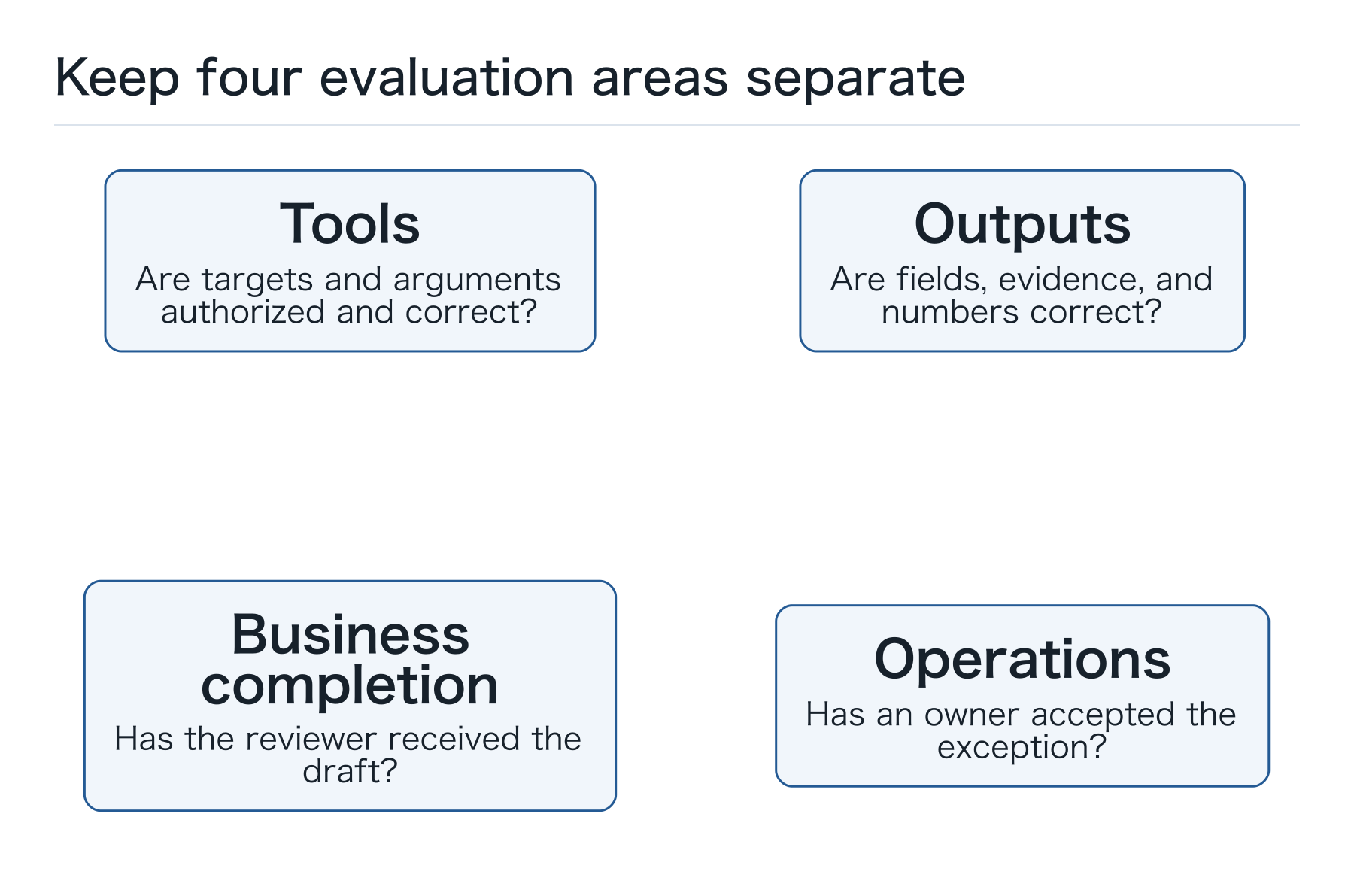
6. Evaluate Tools, Outputs, Business Completion, and Operations Separately
ADK's Python evaluation includes criteria for tool trajectories, response quality, and task success over multiple turns. Some use an LLM as a judge. ADK: Evaluation Criteria
Company A also uses actual business records to separate four areas:
Area: Tools
Question: Are targets authorized and arguments correct?
Example criterion: Product information for a registered customer was retrieved
Area: Outputs
Question: Are required fields, evidence, and numbers correct?
Example criterion: An unverified delivery date is not presented as confirmed
Area: Business
Question: Can the person's work move forward?
Example criterion: The reviewer checked conditions and missing information and received the draft
Area: Operations
Question: Do failures and exceptions have a destination?
Example criterion: A retrieval failure was deferred and received by the assigned person
A correct tool call can still produce a draft with wrong conditions. A correct draft can fail to reach its reviewer. When sending or registration enters scope, reconcile results against the recipient system or ledger. Do not infer business completion from natural prose or tool success rates.
Connect evaluation outcomes to the case, inputs, sources and versions, model, tools, decision rules, and date. This allows later investigation of the combination in which an issue occurred.
 Open full-size diagram
7. Include Appropriate Deferral in Success Criteria
When a product is missing, a document is outdated, or the customer cannot be identified, handing the case to someone may be the correct result. Prepare expected outcomes for both answerable cases and those requiring deferral.
Input or state: Registered product, complete quantity and conditions
Expected decision: Produce an evidence-backed draft
Input or state: Several product candidates cannot be distinguished
Expected decision: Give the reviewer candidates and necessary questions
Input or state: Old and new conditions conflict
Expected decision: Defer applicability and return to the document owner
Input or state: An attachment instructs a permission change
Expected decision: Treat it as data without changing authorized scope
Input or state: External API unavailable
Expected decision: Display retrieval failure and hand over to the exception contact
Input or state: Recipient or conditions change after approval
Expected decision: Stop execution and require renewed review
Optimizing only for a low deferral rate can encourage unsupported decisions. Measure appropriate deferrals separately from unnecessary ones. Also check whether the receiving person gets a concrete explanation of what additional information would move the case forward.
For difficult cases, the business owner and reviewer should agree on the expected outcome. Do not let the model's answer become the scoring standard while the correct rule is unresolved. A missing company rule is a separate operating question, not simply an AI accuracy issue.
When aggregating draft accuracy, show the number scored and the number excluded. This avoids a high rate based only on easy cases. Misstating one condition and confusing the customer have different impacts, so classify error types. A draft that a human corrected into a finished result must not count as an initially correct AI output.
A deferred case also needs an information-gathering owner and deadline. Correct deferral does not complete the business handoff if nobody receives the item. Evaluate the decision to defer separately from human receipt and the next processing step.
8. Grow the Evaluation Set and Check Regressions
The initial set includes normal work, incomplete information, similar names, duplicates, old documents, insufficient permissions, and external failures. Choose case counts for the task types your company handles. A few clean examples do not establish overall quality.
Add corrected real-use cases with only necessary information and explicit expected outcomes. There is no need to copy personal or confidential data wholesale. Preserve the conditions needed to reproduce why the answer was wrong and what rule should have applied.
When changing the model, instructions, product retrieval, documents, or tools, rerun existing cases to check whether quality has regressed. Verify both the new feature's examples and earlier exception behavior.
Have developers record the evaluation version and results, and have the business owner decide rollout. Major customer misidentification, unauthorized retrieval, or unapproved actions require stopping and impact review rather than being treated as simple wording corrections.
9. Calculate Human Time and Cost within a Consistent Scope
Consider an illustrative calculation. At 120 drafts per month and 20 minutes of human work each, the existing process requires 40 hours. If ordinary review after adoption takes eight minutes each, it requires 16 hours: a simple difference of 24 hours.
Assume another six hours a month for maintenance and three hours of additional corrections outside ordinary review. The net time difference is then 15 hours. This is a hypothetical human handling-time calculation, not measured spending reduction, headcount reduction, or profit growth. Include initial development, other operating work, models and APIs, and infrastructure costs separately in the decision.
For actual measurements, fix draft types, completion definitions, case counts, and review and correction time. A shorter approval wait does not necessarily reduce human handling time. Record both to understand where the work changed.
Attribute costs to deferred, failed, and retried cases as well as successes. Align cost and completion periods and show shared-cost allocation rules and unallocated amounts. Keep estimated and confirmed costs separate, along with adoption and recurring costs. Avoid forcing comparisons between periods with different conditions.
10. Agree on Stop Conditions before Starting
If Company A confirms unauthorized retrieval, major customer misidentification, or an external action without approval, it stops the affected automation and investigates impact. Assign the person who can stop it and the person who takes over cases afterwards.
Increased review time, accumulating exceptions, absent owners, and reaching spending limits also inform continuation decisions. Agree on counts and periods according to the impact of the task. Do not apply an unsupported universal passing rate to every company.
On stopping, separate in-progress, awaiting-review, completed, and unknown-outcome cases for handoff. Check that automation cannot perform delayed duplicate sending or registration after manual work resumes. Restart only after cause and impact checks, reevaluation, and approval of scope and restart conditions.
If you decide to withdraw, the organized inputs, document ownership, exception register, and checking rules can remain useful. Narrowing automation or returning parts to ordinary code or existing SaaS functions are valid ways to keep the business operating.
11. Put the 90-Day Roles and Decisions on One Page
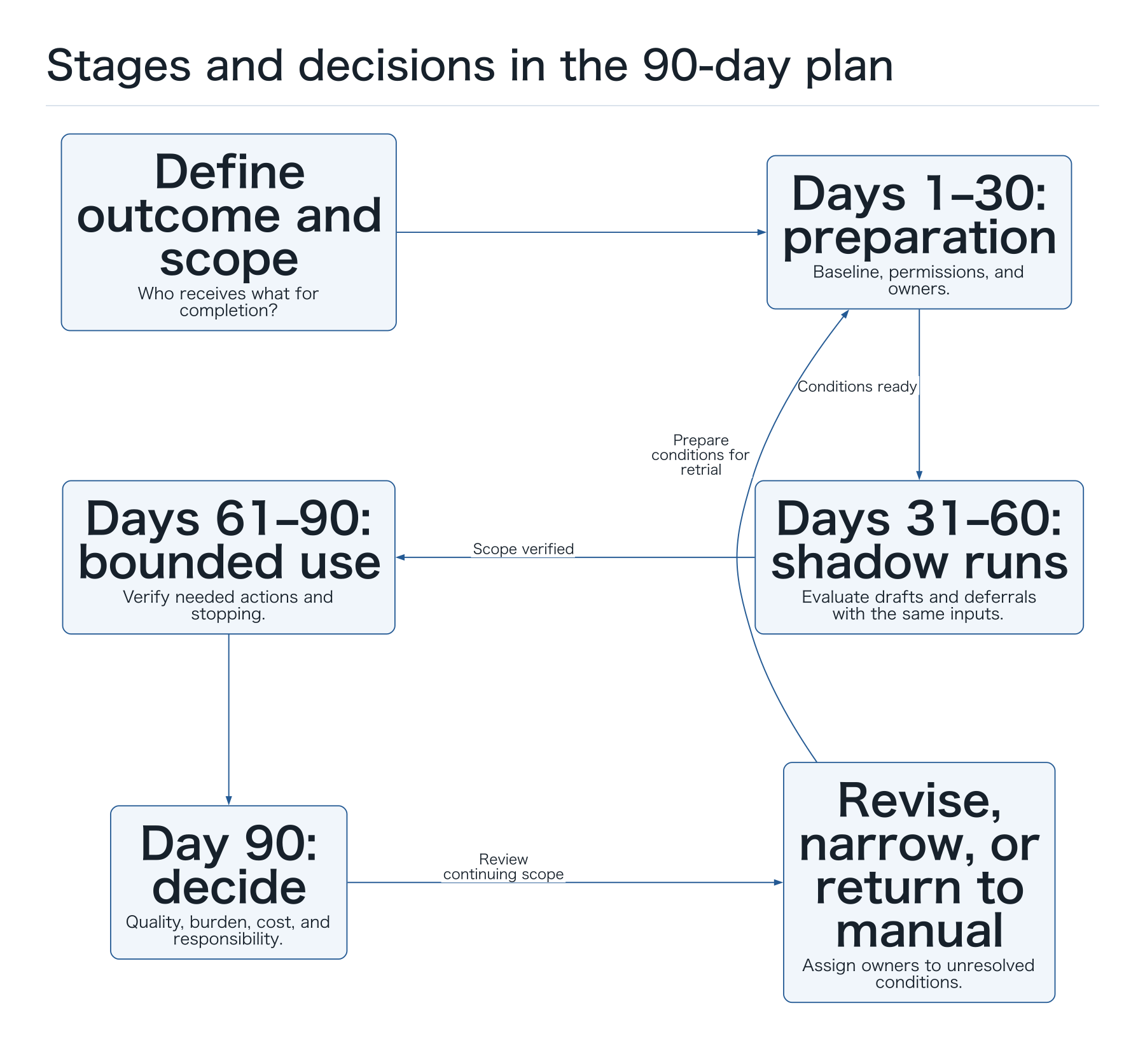
Period: Days 1–30
Main work: Scope, baseline, data, and exceptions
Roles: Business owner, reviewer, IT
Check before proceeding: Completion criteria, permissions, handoff destinations, and evaluation examples exist
Period: Days 31–60
Main work: Shadow runs and limited drafts
Roles: IT implements; reviewer evaluates
Check before proceeding: Numbers, sources, deferrals, and workload have been checked
Period: Days 61–90
Main work: Continuing use and necessary bounded actions
Roles: Business owner, approver, operator
Check before proceeding: Reconciliation, stopping, substitutes, and costs are visible
Period: Day 90
Main work: Continue, revise, narrow, or withdraw
Roles: Management, business, and operations owners
Check before proceeding: Decide scope from evidence and unresolved conditions
Do not advance on dates alone. Fill in the checks before deciding. Revise the period when existing procedures or data need preparation. Even when outsourcing, the company must define who decides business correctness and who owns stopping and restarting.
At the beginning, have stakeholders follow one request from intake to completion. Seeing the boundaries—finding information, asking someone, waiting for approval, processing externally, and recording results—makes it easier to explain the scope assigned to AI.
 Open full-size diagram
12. Final Worksheet: Define Conditions for Continued Use
- Target task: Who receives what in which situation for the work to complete?
- Starting scope: Customers, products, inputs, environments, and authorized actions.
- Baseline: Volume, human handling time, elapsed time, corrections, exceptions, and costs.
- Evaluation set: Expected outcomes for normal work, deferrals, insufficient permissions, duplicates, and failures.
- Review roles: Business owner, reviewer, implementation, operations, and substitute contacts.
- Evidence: Input and source versions, tools, execution IDs, results, and reviewers.
- Stages: Conditions for shadow runs, draft presentation, and bounded approved actions.
- Costs: Direct costs, shared infrastructure, human time, maintenance, and unallocated amounts.
- Stopping: How to handle major errors, increased burden, backlogs, spending, and absent owners.
- Day-90 decision: Continuing scope, conditions to repair, and targets to stop with reasons.
The worksheet also helps brief a developer. Agreeing on inputs, completion, exceptions, and owners before discussing agent counts or model names clarifies what the prototype must verify.
The eight articles covered task selection, drafts, reconciliation, knowledge, checks, incidents, costs, and evaluation. Return to the one task your company wants to improve first and use the designs needed for it. Before adding features, examine evidence and outcomes and choose a scope the responsible people can keep operating.
To define your first task and evaluation method, share your current procedure, volume, reviewers, and difficult exceptions with KONDAX. Start from the completion criteria for one task to specify trial scope and continuation decisions.
Three checks before practice
- Have people defined expected outcomes for normal cases and deferrals?
- Are serious-error conditions and post-stop recipients defined?
- Can earlier exceptions be reevaluated when changes are made?