Automating SME work and infrastructure with ADKPart 6 of 11
AI-Assisted Incident Response: An SRE Design for Investigation, Approval, and Recovery
Plan AI-assisted incident response with ADK: separate evidence, hypotheses, approval, and recovery, with bounded actions, outcome checks, handoffs, and postmortems.

In this article
What you will learn
Manage observations, hypotheses, approvals, and recovery separately.
Have a person check the target and version of the execution plan.
Reconcile orders and pending work even after an action succeeds.
Part 6 of the series | Connect AI investigation support to accountable human decisions. Technical information verified as of October 14, 2026.
During the morning ordering rush, a customer reports that submitting an order does not return a receipt ID. The monitoring dashboard shows errors, and an application update took place shortly before. The person responsible must investigate the cause while updating sales and contacting the maintenance provider. Managing these tasks at once can be demanding in a small organization.
An AI agent that collects logs and change history and organizes investigation options may support the initial response. This requires a design that manages observed facts, possible causes, approved actions, and recovery verification separately. Generating a plausible explanation does not resolve an incident.
We continue with the fictional equipment and parts distributor, Company A, with 35 employees. One person covers internal IT and infrastructure, supported by a sales manager and an external maintenance provider. The company, times, procedures, and conditions are illustrative assumptions; they do not describe a real deployment or recovery result. We move from the previous article's daily checks to incident investigation and bounded recovery execution.
1. What to Take from Reported SRE Operations
Google SRE's published AI operations material describes investigation assistance and human approval for critical actions. This reports Google's operating program; it does not mean that all of these controls are standard ADK features. Google SRE's published material
For an SME, use the structure as a reference: who owns the response, what evidence they see, and which actions they authorize. Google's outcomes do not establish that your company will achieve the same improvement. Staffing, service architecture, customer impact, and maintenance contracts all affect the appropriate scope.
The recovery flow below is our proposed design informed by that material. Running an official sample, evaluating historical logs, and handling customer orders in production are separate verification stages.
2. Define Responsibility and Completion Criteria
Company A first assigns three responsibilities. The incident owner decides impact and response priorities. The investigator organizes observations and response options. The communication owner shares updates among sales, customer support, and the maintenance provider.
One person may hold more than one responsibility in a small team. Still, the incident record must show who currently owns each task. Sending a request to an external provider does not complete an investigation handoff. Confirm receipt, the time they can respond, and the next update time.
In this example, recovery is complete when the agreed order acceptance measurement returns to its target level, the customer path is verified, and unaccepted, duplicate, and pending warehouse-transfer orders have been checked. An application that responds again does not complete the business recovery if some orders are still missing.
Design principle: AI organizes evidence and proposes options. The approver reviews the target and impact. Execution code performs only permitted actions. A responsible person verifies the business result.
3. Set the Initial Scope from the Customer's Symptoms
Suppose, for our example, that an inquiry about failed ordering arrives at 9:10 a.m. Record the investigation start, reported symptoms, target service, and the range of customers potentially affected. Do not assume immediately that the problem affects either one customer or the entire order service.
Use the SLI from the previous article: eligible requests arriving at the service entry point form the denominator, and requests with an issued receipt ID and an acceptance-ledger entry form the numerator. Apply the same definitions for resubmissions of the same request ID, internal errors, and timeouts, and compare a fixed window. A customer inquiry and evidence that every request is failing are different observations.
Set priority using operating rules agreed in advance. Company A classifies a stopped ordering service with customer impact as P1 and contacts the incident owner. For a partial delay with time before shipping and an alternative acceptance channel available, assess business impact before assigning priority. Labels such as P1 and their conditions are examples that each company must agree for itself.
Before asking AI to search all logs, define the initial observation window, service scope, record limit, and investigation time allowance. Repeatedly sending the same checks to support channels or external APIs adds work. Limit scope with the understanding that reads also create load and cost.
4. Start ADK Investigation Support with Evidence Collection
Divide the investigation flow into intake, evidence collection, validation in code, hypothesis organization, and presentation to the responsible person. Collect errors, latency, traffic, pending orders, recent application changes, and dependency status for the defined window. Record unavailable information as missing.
Before passing data to AI, verify its retrieval time, environment, service ID, and aggregation conditions. Put the target into both tool inputs and results so that test-environment logs are not mixed into production evidence. A zero-row result must distinguish “no errors found” from “could not read because permission was insufficient.”
Limit investigation permissions to company-managed targets and necessary time windows. If records are separated by business customer, validate the authenticated user's viewing scope in retrieval code. A tool for investigating an authorized service must not become an unrestricted gateway to other customers or projects.
AI builds a timeline and hypotheses from validated values. Instructions embedded in raw logs do not authorize permission changes. Separate evidence with confidential information removed from links to originals that authorized investigators can view, and include only necessary details in communications.
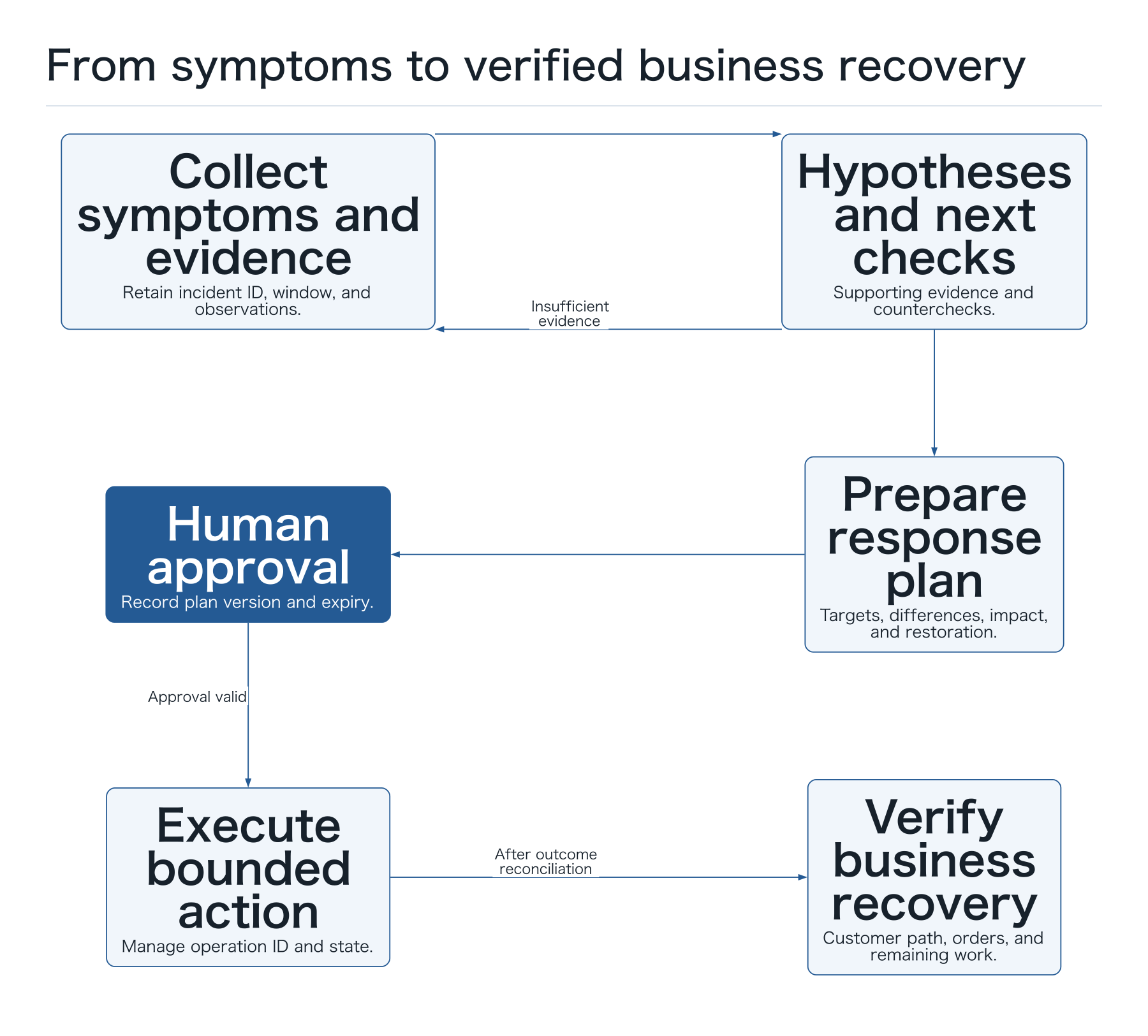 Open full-size diagram
5. Attach Supporting Evidence and Counterchecks to Hypotheses
Google SRE describes troubleshooting as a process of forming hypotheses from observations and repeatedly testing them. Google SRE: Effective Troubleshooting
Suppose the illustrative investigation finds an update at 9:05 a.m. and increased errors from 9:09 a.m. Their timing is a reason to investigate whether the update is related. Delays in an external integration and the morning traffic increase are also possibilities. For each candidate, AI should list what has been observed and what needs checking.
Possible cause: Application update
Example supporting observation: Errors increased on a particular path after the update
Next check: Change diff, affected paths, compatibility of the previous version
Possible cause: Dependency latency
Example supporting observation: Waiting time for dependency responses increased
Next check: Dependency status and scope of further queries
Possible cause: Processing load
Example supporting observation: Requests and queues increased together
Next check: Capacity, waiting time, breakdown of affected requests
The observations and times in the table are hypothetical. In a real investigation, do not fill in missing evidence as though it supported a hypothesis. When several candidates remain, choose the next check by priority, the load it creates, and how its result would affect the response decision.
Do not say that AI has found the cause when it has only proposed a hypothesis. Report the stage clearly when supporting tests, post-recovery observations, or subsequent investigation are still needed.
6. Turn a Response Option into a Reviewable Change Plan
Mitigation may be necessary while the root cause is still being investigated. For Company A, one candidate is an existing procedure that returns the target service's traffic to a previous application version whose compatibility has been checked. This must be validated for each environment; it is not a universally effective recovery method.
The proposal includes resource IDs, the current and previous versions, affected users, the expected effect, potential problems, execution timing, post-action checks, and stop conditions. An update that changes data may not permit an application-only rollback, so check compatibility and recovery procedures beforehand.
A dry run checks targets, planned differences, permissions, and the number of resources affected. Its success does not ensure that production dependencies or traffic will match. Reread target state immediately before execution; if it differs from the plan, return for approval.
Show the reviewer evidence, a change diff, impact, alternatives, and recovery steps rather than a large transcript of AI's internal reasoning. The incident owner needs a format that supports deciding whether to act, investigate further, or hand the issue to the maintenance provider.
7. Keep Approval Verifiable Outside the Conversation
ADK Tool Confirmation is experimental. Its current documentation lists DatabaseSessionService and VertexAiSessionService as unsupported. ADK: Action confirmations
For production changes, design an operational approval register alongside the dialog. It connects a conversational “approved” to an authenticated approver's authorization of a specific plan.
At minimum, record the operation ID, incident ID, environment, resource targets, plan version, approver ID, approval time, and expiry. Save the diff associated with the targets and plan, and have the execution tool check the same version. If the target, action, or version changes after approval, require a fresh review.
If the approver is unavailable, use the substitute contact agreed in advance. AI must not execute an expired approval because the situation is urgent. Where the company has emergency-change rules, design for their required permissions and records, distinguishing them from normal approval.
This system connects accountable decisions to concrete operations. Creating a record does not establish compliance with every law or contractual requirement.
8. Bound Recovery Actions and Retries
The execution tool should accept only specific, validated operations. Do not turn arbitrary text into production commands. Code checks the environment, action type, number of targets, frequency, and approval state, then performs the operation with dedicated permissions.
Repeated investigation may cause AI to propose the same response multiple times. Use the operation ID and execution state in the register to avoid applying the same change again when the same request returns. This is the idempotency required in our example.
ADK Python v2.9.0 describes rerunning failed workflow nodes on resume and requires idempotent handling of external side effects. Resume does not automatically prevent duplicate execution. ADK v2.9.0 release notes
Track operations as not started, running, succeeded, failed, or outcome unknown. Check the register before starting, and ensure that competing start registrations for the same operation ID allow only one to proceed. Use a transaction or conditional update for registration to prevent a race between the check and the registration. Map an external API's idempotency key where it supports one. Register updates and external execution are separate systems, however; do not assume that this alone guarantees execution exactly once. Design result reconciliation as well.
Query the Outcome Before Resending a Timed-Out Action
An action may have completed externally even when its response times out. Query current version and operation status first. If the result remains uncertain, mark the outcome unknown and return the case to a person. Do not resend blindly.
In this example, retries are limited to agreed temporary errors, with maximum attempts and waiting periods. Choose those limits and observation windows for the service. Stop retrying on permission failures, plan-version mismatches, or worsening business impact, and hand the case over for another decision.
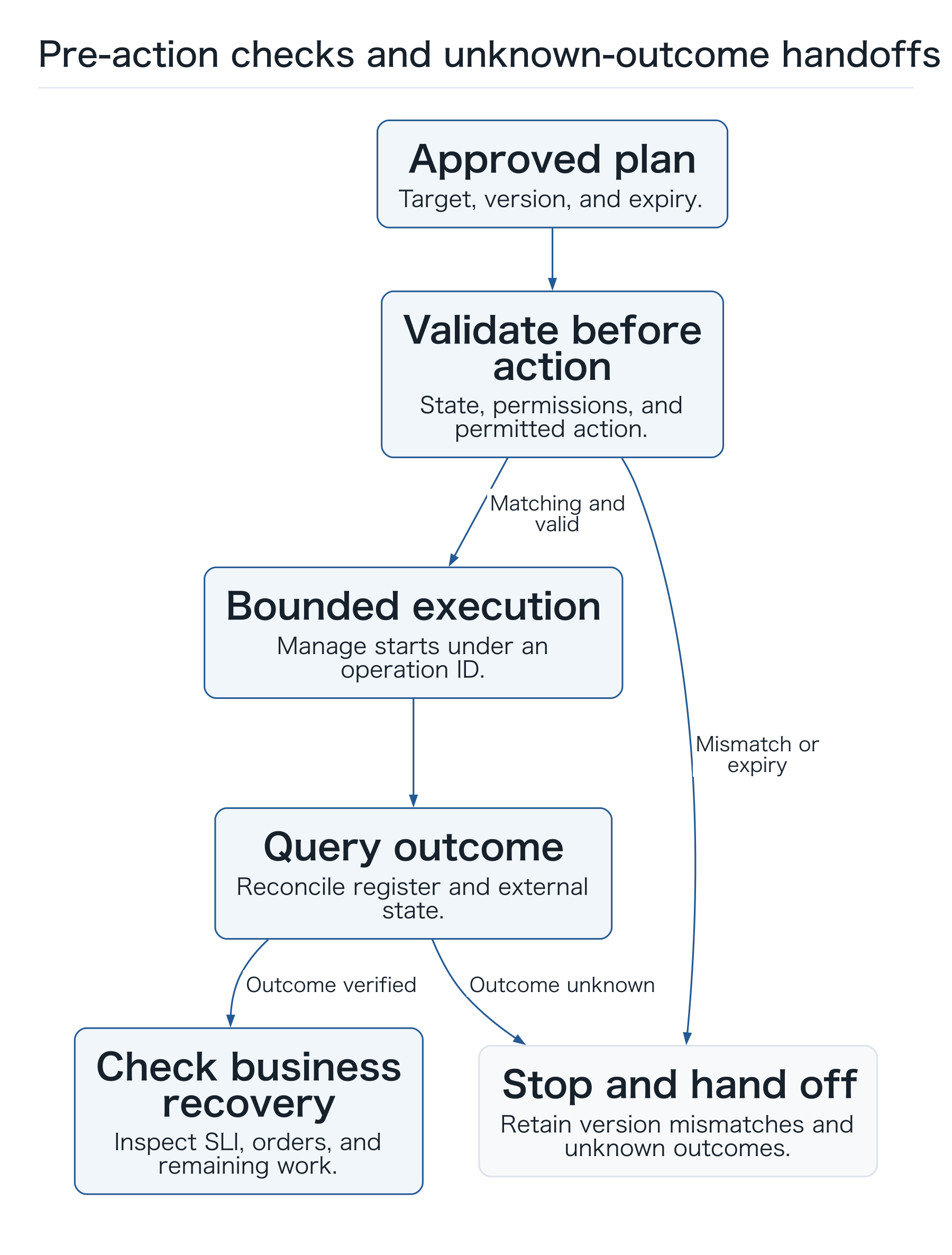 Open full-size diagram
9. Verify Recovery Against Orders and the Customer Path
A success response from a recovery tool reports the change operation's result. To verify order-service recovery, examine the consistently defined SLI, the path from interface to acceptance, the order ledger, and warehouse transfer state. Record action success and business recovery separately.
For orders resubmitted during the incident, reconcile request IDs and receipt IDs to classify unaccepted, duplicate, and pending orders. Put items requiring human checks into a list with the customer, request, evidence, owner, and deadline. State the reconciliation coverage so that AI does not infer that every order has been processed.
Include the follow-up observation period and criteria for renewed deterioration in the plan. This distinguishes a few quiet minutes of apparent health from successful acceptance during the morning traffic load. Once the verified conditions are met, the incident owner declares recovery.
Improvement after mitigation does not necessarily establish the root cause. Separate statements such as “the indicators improved after the action” and “the cause remains under investigation.” Customer updates should reflect the same strength of evidence.
10. Make Incident Records and Handoffs Readable Later
Gather information into one incident record so that investigation can continue when responsibility changes. The following is a template for that record.
Field: Intake and impact
What to record: First report time, customer symptoms, affected scope, priority
Field: Observation conditions
What to record: Service, window, retrieval time, SLI denominator and values
Field: Changes and hypotheses
What to record: Recent changes, supporting evidence, counterevidence, unverified items
Field: Approval and execution
What to record: Operation ID, plan version, approver, expiry, execution state
Field: Recovery checks
What to record: Customer path, ledger reconciliation, remaining work, follow-up observation criteria
Field: Handoff
What to record: Current owner, next check, deadline, receipt, contact
When AI updates the record, keep new observations distinct from earlier hypotheses. Save the reviewer and time for human-verified items. Preserve what changed when records are corrected later.
Provide the receiving person with key points and references, and confirm receipt. Make unverified items, stopped actions, expired approvals, and unknown outcomes prominent. Tell customers the current impact and next planned update within the necessary scope; do not send a proposed cause as a confirmed fact.
11. Use the Postmortem to Improve the Next Response
After recovery, a postmortem organizes the timeline, customer impact, response, what worked, and what delayed verification. Reconcile the incident record with the original evidence rather than relying on memory alone. If AI drafts the document, a responsible person still checks facts and wording.
Company A turns findings into specific work: insufficient observations, unclear procedures, time spent locating an approver, or inability to verify an external operation's outcome. Move beyond evaluating individuals and create tasks that improve retrieval, runbooks, contacts, and tool controls.
Give each improvement an owner, deadline, completion criteria, and verification method. For “improve monitoring,” specify which requests to measure, which condition triggers a notification, and who receives it. For “improve AI,” add incorrect hypotheses or missing-data examples to the evaluation set and rerun them after the change.
There is no need to automate everything at once. Completing one improvement—better evidence for the next incident, a known substitute owner, or a way to query an unknown outcome—can be easier for a small organization to operate.
12. Evaluate Eight Cases Before Connecting Execution
Before connecting recovery actions, verify the following in a test environment or with historical records. Include a stage that tests stop and handoff decisions without making actual production changes.
- A normal day does not produce an unnecessary incident declaration.
- Missing logs do not lead to an unqualified healthy status.
- A recent update remains a possible cause until verified.
- Customer records outside the viewer's scope are not retrieved.
- Changes to targets or plans after approval stop execution.
- Duplicate operation IDs trigger controls that prevent duplicate actions.
- A missing external API response leads to a status query or human handoff.
- An action success without order-service recovery does not complete the incident.
Score hypothesis quality, evidence coverage, approval validation, execution controls, and business recovery separately. Natural AI prose is not enough to pass the whole recovery flow. Record human handling time during the initial response, unnecessary queries, incorrect proposals, remaining work, and cost.
Incidents differ, so avoid generalizing a recovery-time improvement percentage from a small number of cases. First fix the service and incident category being evaluated, then examine where human work increased and where waiting decreased.
13. Your Incident Response Design Worksheet for This Week
Complete the following for one service to make AI's role and human responsibility concrete.
- Business task to protect: What the user should complete and how it is measured.
- Owners: Incident decisions, investigation, communication, change approval, and substitutes.
- Initial investigation: Targets, time windows, record limits, and access permissions.
- Evidence display: A report structure separating observations, hypotheses, and unverified items.
- Response conditions: Permitted actions, prechecks, impact, and stop criteria.
- Approval: Operation ID, plan version, approver, expiry, and renewed review when anything changes.
- Execution: Unique keys, state register, retry limits, and unknown-outcome handling.
- Recovery verification: Customer path, order ledger, remaining work, and continued observation.
- Handoff: Receipt, next checks, communication deadlines, and necessary references.
- Improvement: Evaluation cases, postmortem ownership, and completion criteria.
Check whether a substitute who reads the runbook can explain which targets they may act on and when they must stop. Treat unexplained items as unresolved operating questions to settle, rather than gaps to fill through model capability.
Part 7 applies these approval and execution controls to cloud cost recommendations. Changes intended to reduce spending also need checks of order-service quality and recovery options.
To organize your initial response and handoffs to a maintenance provider, share a service overview, current procedures, and frequently unverified items with KONDAX. Those details help define a scope your company can take responsibility for operating.
Three checks before practice
- Can approver, targets, plan version, and expiry be checked?
- Can repeat requests and unknown outcomes be distinguished?
- Will unaccepted orders, duplicates, and warehouse backlog be checked?